Question Bank
Browse and filter NCEA Level 3 Calculus questions (AS91578 - Differentiation)
30 questions found
ONE(a)Achievement
(a) Differentiate .
*You do not need to simplify your answer.*
*You do not need to simplify your answer.*
Chain RuleRadicalPolynomial+1 more
ONE(b)Achievement
(b) A curve is defined by the equation .
Find the gradient of the tangent to this curve when .
*You must use calculus and show any derivatives that you need to find when solving this problem.*
Find the gradient of the tangent to this curve when .
*You must use calculus and show any derivatives that you need to find when solving this problem.*
Product RuleTrigonometricPolynomial+1 more
ONE(c)Merit
(c) For the function below, find the range of values of for which the function is decreasing.
*You must use calculus and show any derivatives that you need to find when solving this problem.*
*You must use calculus and show any derivatives that you need to find when solving this problem.*
Chain RuleMixedLogarithmic+1 more
ONE(d)Merit
(d) Find the -value(s) of any stationary points on the graph of the function below, and determine their nature.
y = (2x - 1)e^{-2x}
*You must use calculus and show any derivatives that you need to find when solving this problem.*
y = (2x - 1)e^{-2x}
*You must use calculus and show any derivatives that you need to find when solving this problem.*
Product RuleMaxima MinimaMixed+3 more
ONE(e)Excellence
(e) A curve is defined by the equation , where .
The curve has a point of inflection at the point P.
Find the equation of the tangent to the curve at the point P.
*You must use calculus and show any derivatives that you need to find when solving this problem.*
The curve has a point of inflection at the point P.
Find the equation of the tangent to the curve at the point P.
*You must use calculus and show any derivatives that you need to find when solving this problem.*
InflectionTangent NormalMixed+3 more
THREE(a)Achievement
(a) Differentiate .
*You do not need to simplify your answer.*
*You do not need to simplify your answer.*
Product RuleChain RuleReciprocal Trig+2 more
THREE(b)Achievement
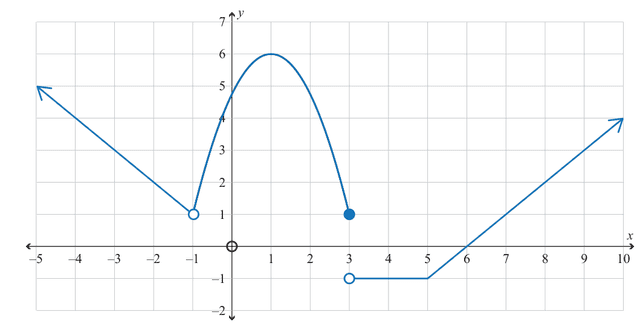
(b) The graph below shows the function .
(i) For the function above, find the value(s) of where is continuous but not differentiable.
(ii) For the function above, find the value(s) of where .
(iii) What is the value of ?
State clearly if the value does not exist.
(i) For the function above, find the value(s) of where is continuous but not differentiable.
(ii) For the function above, find the value(s) of where .
(iii) What is the value of ?
State clearly if the value does not exist.
Graph PropertiesMaxima MinimaMixed+2 more
THREE(c)Merit
(c) Find the -value(s) of any stationary point(s) on the graph of the function .
*You must use calculus and show any derivatives that you need to find when solving this problem.*
*You do not need to determine the nature of any stationary point(s) found.*
*You must use calculus and show any derivatives that you need to find when solving this problem.*
*You do not need to determine the nature of any stationary point(s) found.*
Quotient RuleMaxima MinimaRational+1 more
THREE(d)Merit
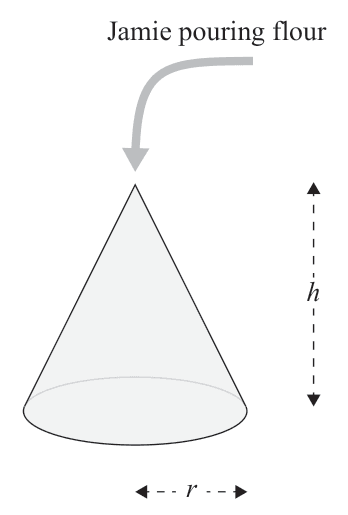
(d) Jamie is doing some baking and pouring the flour to form a conical pile.
The height of the pile is always the same as the diameter of the base of the cone.
If the flour is being added at a constant rate of per second, at what rate is the height increasing when the pile is in height?
*You must use calculus and show any derivatives that you need to find when solving this problem.*
Note that volume of a cone .
The height of the pile is always the same as the diameter of the base of the cone.
If the flour is being added at a constant rate of per second, at what rate is the height increasing when the pile is in height?
*You must use calculus and show any derivatives that you need to find when solving this problem.*
Note that volume of a cone .
Related RatesMixedRelated Rates+1 more
THREE(e)Excellence
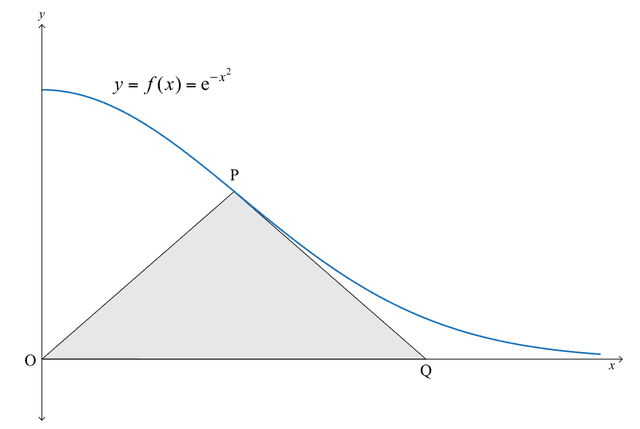
(e) The diagram below shows part of the graph of the function , where .
The point P lies on the curve and the point Q lies on the -axis so that OP = PQ, where O is the origin.
Prove that the largest possible area of the triangle OPQ is .
*You do not need to show that the area you have found is a maximum.*
*You must use calculus and show any derivatives that you need to find when solving this problem.*
The point P lies on the curve and the point Q lies on the -axis so that OP = PQ, where O is the origin.
Prove that the largest possible area of the triangle OPQ is .
*You do not need to show that the area you have found is a maximum.*
*You must use calculus and show any derivatives that you need to find when solving this problem.*
OptimisationChain RuleExponential+2 more
TWO(a)Achievement
(a) A function is defined parametrically by the pair of equations:
and .
Find an expression for .
and .
Find an expression for .
ParametricTrigonometricPolynomial+1 more
TWO(b)Achievement
(b) An object is travelling in a straight line. Its displacement, in metres, is given by the formula
, where and is time, in seconds.
Find the velocity of this object when second.
*You must use calculus and show any derivatives that you need to find when solving this problem.*
, where and is time, in seconds.
Find the velocity of this object when second.
*You must use calculus and show any derivatives that you need to find when solving this problem.*
Chain RuleLogarithmicFind Rate
TWO(c)Merit
(c) Show that is a solution to the equation
Chain RuleProofTrigonometric+1 more
TWO(d)Merit
(d) Consider the function , .
Find the coordinates of the point of inflection on the graph of the function.
*You can assume that your point found is actually a point of inflection.*
*You must use calculus and show any derivatives that you need to find when solving this problem.*
Find the coordinates of the point of inflection on the graph of the function.
*You can assume that your point found is actually a point of inflection.*
*You must use calculus and show any derivatives that you need to find when solving this problem.*
Quotient RuleInflectionLogarithmic+1 more
TWO(e)Excellence
(e) The graph of the function , where is a non-zero constant, has a single turning point at Q.
Find the -coordinate of the point Q.
*You must use calculus and show any derivatives that you need to find when solving this problem.*
Find the -coordinate of the point Q.
*You must use calculus and show any derivatives that you need to find when solving this problem.*
Quotient RuleChain RuleMixed+2 more
ONE(a)Achievement
(a) Differentiate .
*You do not need to simplify your answer.*
*You do not need to simplify your answer.*
Chain RuleRadicalFind Derivative
ONE(b)Achievement
(b) Find the rate of change of the function when .
*You must use calculus and show any derivatives that you need to find when solving this problem.*
*You must use calculus and show any derivatives that you need to find when solving this problem.*
Product RuleChain RuleMixed+3 more
ONE(c)Merit
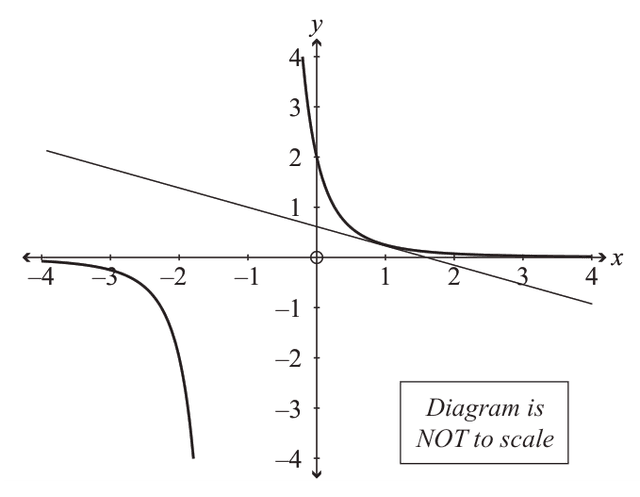
(c) The graph shows the curve , along with the tangent to the curve drawn at .
A second tangent to this curve is drawn which is parallel to the first tangent shown in the diagram.
Find the -coordinate of the point where this second tangent touches the curve.
*You must use calculus and show any derivatives that you need to find when solving this problem.*
A second tangent to this curve is drawn which is parallel to the first tangent shown in the diagram.
Find the -coordinate of the point where this second tangent touches the curve.
*You must use calculus and show any derivatives that you need to find when solving this problem.*
Chain RuleTangent NormalRational+2 more
ONE(d)Merit
(d) The diagram below shows a tangent passing through the point P which lies on the circle with parametric equations and .
Show that the equation of the tangent line is .
Show that the equation of the tangent line is .
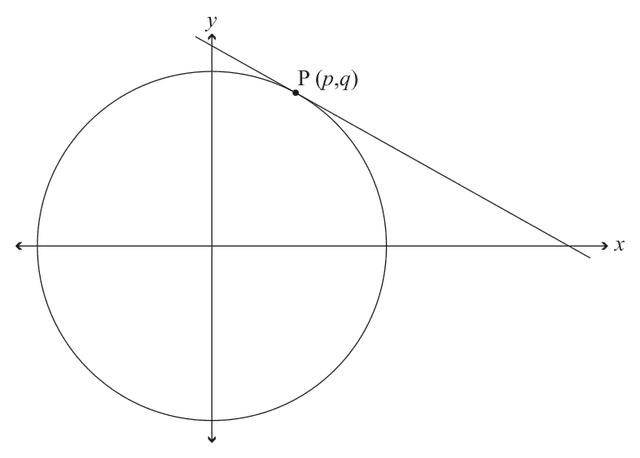
ParametricProofTrigonometric+2 more
ONE(e)Excellence
(e) The graph of , where , is shown.
The total shaded area between the curve and the -axis from to is given by .
A right-angled triangle is now constructed with one vertex at and another on the curve , as shown below.
Show that the maximum area of such a triangle is of the total shaded area.
*You must use calculus and show any derivatives that you need to find when solving this problem.*
*You do not have to prove that the area you have found is a maximum.*
The total shaded area between the curve and the -axis from to is given by .
A right-angled triangle is now constructed with one vertex at and another on the curve , as shown below.
Show that the maximum area of such a triangle is of the total shaded area.
*You must use calculus and show any derivatives that you need to find when solving this problem.*
*You do not have to prove that the area you have found is a maximum.*

OptimisationProduct RulePolynomial+2 more
THREE(a)Achievement
(a) Differentiate .
You do not need to simplify your answer.
You do not need to simplify your answer.
Chain RuleLogarithmicPolynomial+1 more
THREE(b)Achievement
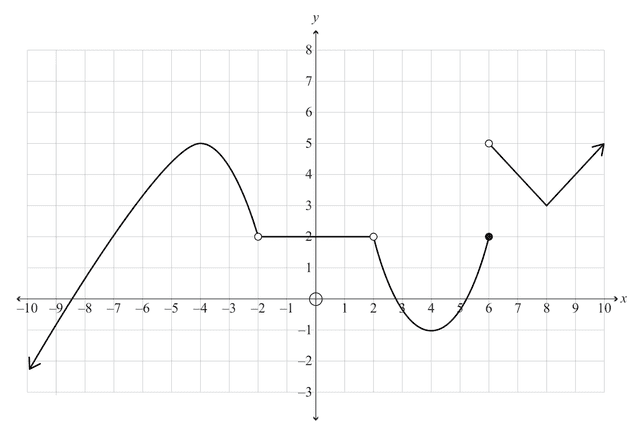
(b) The graph below shows the function .
For the function above:
(i) Find the value(s) of where is continuous but not differentiable.
(ii) Find the value(s) of where and are both true.
(iii) What is the value of ?
State clearly if the value does not exist.
For the function above:
(i) Find the value(s) of where is continuous but not differentiable.
(ii) Find the value(s) of where and are both true.
(iii) What is the value of ?
State clearly if the value does not exist.
Graph PropertiesMaxima MinimaMixed+2 more
THREE(c)Merit
(c) Char goes for a ride on a Ferris wheel. As she rotates around, her position can be described by the pair of parametric equations:
and
where is time, in seconds, from the start of the ride.
Find the gradient of the normal to this curve at the point when seconds, after the start of the ride.
*You must use calculus and show any derivatives that you need to find when solving this problem.*
and
where is time, in seconds, from the start of the ride.
Find the gradient of the normal to this curve at the point when seconds, after the start of the ride.
*You must use calculus and show any derivatives that you need to find when solving this problem.*
ParametricTangent NormalTrigonometric+1 more
THREE(d)Merit
(d) Find the co-ordinates of any stationary points on the graph of the function , identifying their nature.
*You must use calculus and show any derivatives that you need to find when solving this problem.*
*You must use calculus and show any derivatives that you need to find when solving this problem.*
Maxima MinimaChain RuleRational+2 more
THREE(e)Excellence
(e) A power line hangs between two poles.
The equation of the curve that models the shape of the power line can be found by solving the differential equation:
Use differentiation to verify that the function satisfies the above differential equation, where is a positive constant.
The equation of the curve that models the shape of the power line can be found by solving the differential equation:
Use differentiation to verify that the function satisfies the above differential equation, where is a positive constant.
Chain RuleProofExponential+1 more
TWO(a)Achievement
(a) Differentiate .
*You do not need to simplify your answer.*
*You do not need to simplify your answer.*
Quotient RuleTrigonometricRational+1 more
TWO(b)Achievement
(b) Find the gradient of the tangent to the curve at the point where .
*You must use calculus and show any derivatives that you need to find when solving this problem.*
*You must use calculus and show any derivatives that you need to find when solving this problem.*
Chain RuleTrigonometricFind Gradient
TWO(c)Merit
(c) A curve is defined by the equation .
Find the -value(s) of any point(s) on the curve where the tangent to the curve is parallel to the -axis.
*You must use calculus and show any derivatives that you need to find when solving this problem.*
Find the -value(s) of any point(s) on the curve where the tangent to the curve is parallel to the -axis.
*You must use calculus and show any derivatives that you need to find when solving this problem.*
Quotient RuleMixedFind Stationary
TWO(d)Merit
(d) Find the -value(s) of any points of inflection on the graph of the function .
You can assume that your point(s) found are actually point(s) of inflection.
You must use calculus and show any derivatives that you need to find when solving this problem.
You can assume that your point(s) found are actually point(s) of inflection.
You must use calculus and show any derivatives that you need to find when solving this problem.
Product RuleInflectionLogarithmic+2 more
TWO(e)Excellence
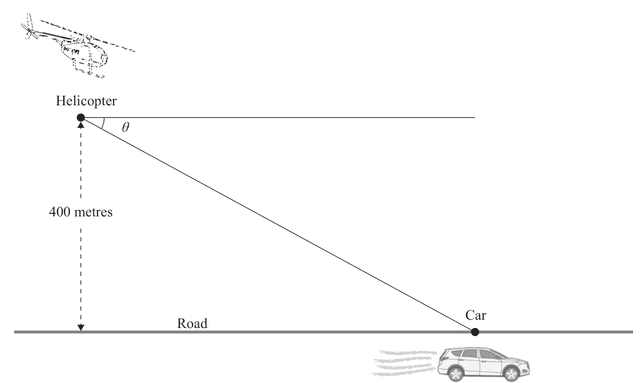
(e) A police helicopter is flying above a straight horizontal section of motorway chasing a speeding car.
The helicopter is flying at a constant speed of and at a constant height of metres above the ground. The helicopter is attempting to catch up with the car.
When the direct distance from the helicopter to the car is metres, the angle of depression, , between the horizontal and the line of sight from the helicopter to the car is increasing at a rate of .
Calculate the speed of the car at this instant.
*You must use calculus and show any derivatives that you need to find when solving this problem.*
The helicopter is flying at a constant speed of and at a constant height of metres above the ground. The helicopter is attempting to catch up with the car.
When the direct distance from the helicopter to the car is metres, the angle of depression, , between the horizontal and the line of sight from the helicopter to the car is increasing at a rate of .
Calculate the speed of the car at this instant.
*You must use calculus and show any derivatives that you need to find when solving this problem.*
Related RatesChain RuleTrigonometric+2 more